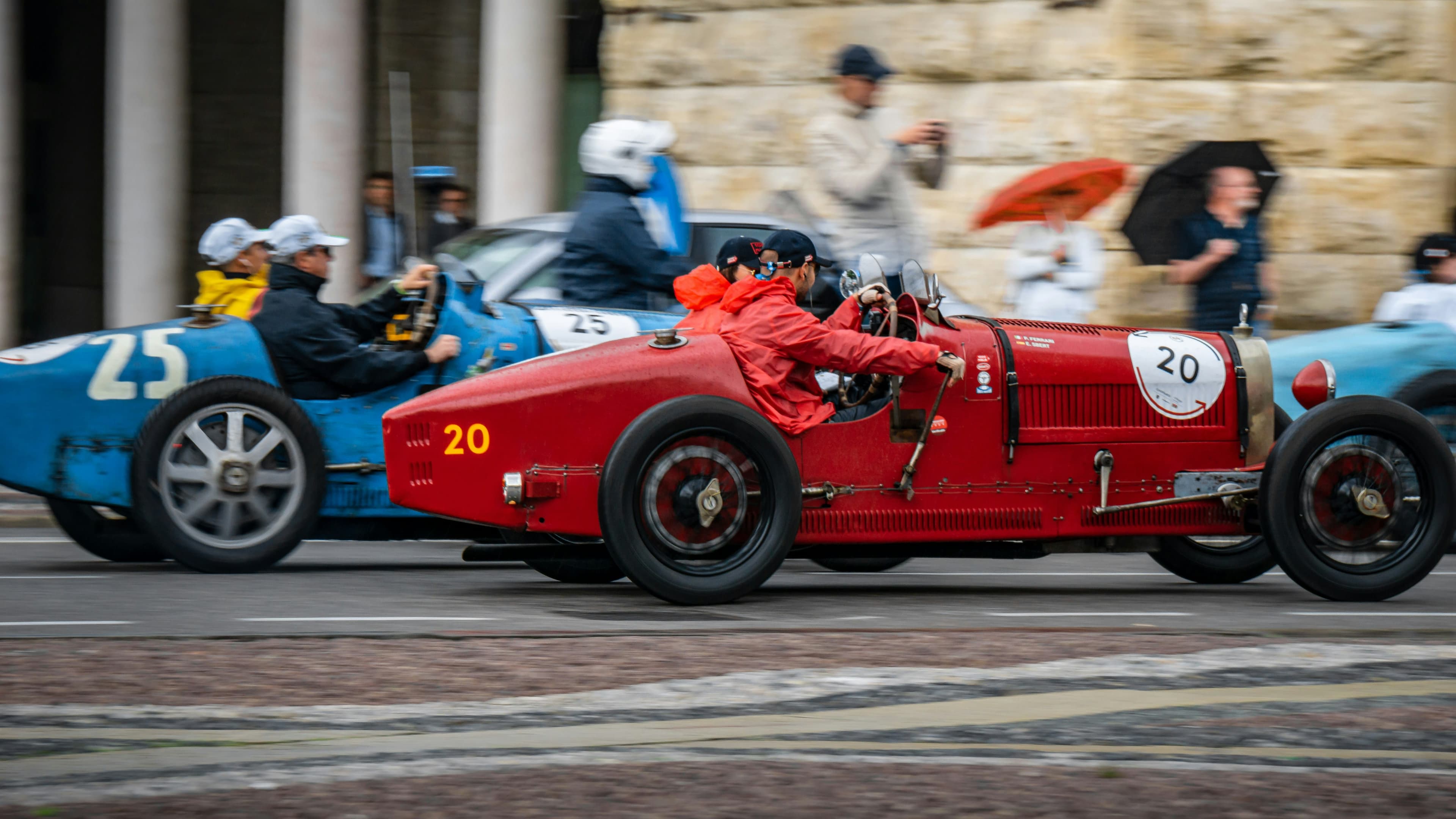
The regularity rally glossary from A to Z
All technical terms at a glance
The world of regularity rallies has its own language. From terms like target time and tripmeter to the charming roadbook symbol names like the sharp hairpin – this glossary explains all the important technical terms clearly and in alphabetical order. You'll find the individual entries in our glossary database.
This glossary is continually expanded. Missing a term? You can send us suggestions via the contact form.
0–9
07er-Kennzeichen
Germany's red classic-car plate (rotes 07-Kennzeichen): one transferable plate for several historic vehicles, usable only for events plus test, transfer and workshop drives – never for everyday use.
A
A-B tasks
Navigation tasks in which two map points A and B must be connected by the shortest permitted route.
Appendix K
The FIA regulations for historic motor sport. They define vehicle classes and eligibility – and permit regularity rallies with an average speed of no more than 50 km/h.
ASN
A country's national sporting authority, recognised by the FIA. It grants licences and permits and issues the HTP and HRCP vehicle documents.
Average speed
The mean speed prescribed by the organiser, to be maintained as precisely as possible over a section.
Average-speed table
Table giving, for a prescribed average speed, the target time for each distance – an aid in regularity stages.
B
Baumaffe
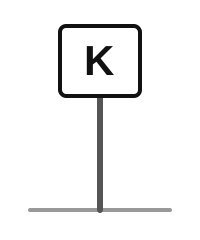
Colloquial term for a silent orientation control: a letter or number sign on a tree, lamppost or post that the co-driver enters in the control card.
Bitsa
British collector slang (from 'bits of this and that') for a car assembled from parts of various vehicles – the opposite of a matching-numbers car.
Bol-pijl
A Dutch-Belgian navigation system: at each junction a dot ('bol') marks your position and an arrow ('pijl') shows the direction to take. Read from left to right.
Bordbuch
German term for the route book of a rally: the description of the route with driving instructions and distances, usually with maps and commentary. Used synonymously with roadbook.
C
Carcass
The load-bearing fabric skeleton inside the tyre: cord plies running from bead to bead that carry load and air pressure. Their arrangement defines the construction – cross-ply or radial.
CAST
US abbreviation for 'Change Average Speed To' – the instruction in a TSD rally to drive a new prescribed average speed from that point on.

Chinesenzeichen
Traditional name for the junction symbols in the roadbook (dot, line and arrow drawings). Today increasingly replaced by the term tulip.
Chronometer
The navigator's precise timing instrument for checking target and actual times while driving.
Classic car
A motor vehicle that is 30 years old or older. The German term Oldtimer matches FIVA's definition of a historic vehicle and is distinct from the younger youngtimer (20 to 29 years).
Clerk of the course
The official responsible for the route and the scoring. Together with the organising committee he or she rules on disputes over classifications and penalties.
Clock synchronisation
Aligning the team's clocks and stopwatches with the official rally time before the start, so its timing matches the organiser's exactly.
Co-driver
The second team member alongside the driver; handles navigation, timing and reading the roadbook.
Competitor Relations Officer
An official (abbreviated CRO) who mediates between the clerk of the course and the crews and advises entrants on questions of rules and regulations. Known in German as the Fahrerverbindungsmann.
Concours d'Élégance
A classic-car exhibition with judging and awards, where the condition, originality and restoration quality of the cars are decisive.
Control point
Defined location on the route where a control takes place – such as a time, transit or passage control.
Correction factor
The factor from the odometer check used to convert the rallymaster's distances to the crew's own odometer – calculated as 'official distance divided by your own'.
Cross-ply tyre
The classic tyre construction in which the carcass plies run diagonally across each other. Standard until the 1960s – and the period-correct fitment for many classic cars.
D
Distance
Precisely measured length of a route section – the basis for calculating target times and average speeds.
Distance recorder
Umbrella term for any in-car device that measures distance – from the series odometer through the more precise tripmeter to digital and GPS-based units. It provides the basis for every distance instruction.
Document check
The pre-start check of the entered vehicle's papers – driving licence, registration document and proof of insurance. Only then is start clearance given. Also called administrative checks.
Drivers' briefing
The meeting before the start at which the clerk of the course explains the schedule, special features and safety points of the event. Often mandatory.
E
Early arrival
Reaching a time control before the prescribed due time. When 'early arrival allowed' is stated, arriving early is not penalised – only lateness counts.
Elektronik-Klasse
German name for the scoring class, mainly in pure regularity rallies, that allows all kinds of odometers and clocks in the car – including digital or GPS-based aids. The counterpart to the Sanduhrklasse.
Entry
The application to the organiser to take part in an event. With the entry – usually together with the entry fee – a crew applies for a starting place.
Entry fee
The participation fee for a classic-car event. Which services it covers is set out in the event's supplementary regulations.
F
FIA
The Fédération Internationale de l'Automobile, founded in 1904, is the world governing body of motor sport. It issues the International Sporting Code and, for historic cars, Appendix K.
FIA board
The standardised boards marking a control: the yellow board as advance warning about 20 m before, and the red board at the control point itself.
FIVA
The Fédération Internationale des Véhicules Anciens, the worldwide federation of historic vehicles founded in 1966. It protects and promotes motoring heritage and is a non-governmental partner of UNESCO.
FIVA ID-Card
An internationally standardised FIVA document for historic vehicles over 30 years old. It records a vehicle's identity, technical data and history, is issued after a physical inspection and serves identification purposes only.
G
Gimmick rally
An American rally type (also GTA – Game, Tour, Adventure) scored not on time and speed but on puzzles, scavenger hunts or tasks along the route.
GPS timing
Modern timing via a GPS box or transponder in the car: it records position and time continuously and allows measuring points with no visible installation on the road.
Grid reference
A map coordinate (Ordnance Survey grid) used as a navigation instruction in British rallies: the navigator plots the given point or route from it onto the map.
H
H-Kennzeichen
Germany's official historic-vehicle plate with an ‘H’ for cars 30+ years old – full everyday use, flat vehicle tax, free access to low-emission zones.
Herringbone
Navigation task in which a central spine line with side ticks shows the roads a route passes without turning into them.
Homologation certificate
A document listing a vehicle's technical modifications compared with the standard production model. It serves to admit the vehicle to an event and is usually required at racing events.

Hourglass
Roadbook symbol for a 180° U-turn: drive in one direction, turn completely and head back. Often at dead ends and turning points.
HRCP
The Historic Regularity Car Pass: a simple vehicle identity document based on an FIA template, restricted for use only in historic regularity rallies.
HTP
The FIA's Historic Technical Passport: the vehicle document for international historic competition. It confirms period specification – but expressly not the car's authenticity or history.
I
Ingetekende lijn
A Benelux navigation system: the route to be driven is pre-drawn on the map as a continuous line and must be followed as accurately as possible in the forward direction.
Interchangeable plate
A Swiss licence plate used alternately on several vehicles – only one of which may be driven at a time. For veteran vehicles, more than two are allowed.
Itinerary
The route prescribed by the organiser that the team must drive in the correct order – set out in the roadbook.
J
Jogularity
A British form of regularity: instead of speed tables, the navigator gets a table of landmarks with their distance and the due arrival time at each.
L
Leg
A major self-contained section of a rally, usually a day's running between two main halts; called Etappe in German.
Liaison stage
A section in stage rallies that runs on public roads from the start to a special stage or between two stages. Normal traffic rules apply and must be obeyed.
Light barrier
Photoelectric timing device that triggers the exact time as the vehicle passes – standard for timing special stages.
Light barrier test
A regularity test in which timing is controlled by photoelectric light barriers. Timing starts at the first barrier and ends at the second, triggered by the front of the car rather than the wheels.
M
Marshal
A mostly volunteer helper – one of the many who make an event possible: they run controls and tests, direct cars and keep everything running smoothly.
Matching numbers
Collector term for a vehicle whose major components (engine, gearbox, axle, frame) still carry the original numbers that match one another and the factory records – an indicator of originality, not of identity.
Maximum time
A penalty time for special stages or tests not completed properly. It is usually calculated as the best time plus a fixed number of minutes.
Minute start
A start procedure in which cars are sent off one after another at one-minute intervals, in start-number order.
N
Navigation rally
Event format where finding the correct route from tricky roadbook instructions matters – not speed (often abbreviated Ori).
Negative control
The opposite of a passage control: a no-go point or section that must not be driven. Passing it earns penalty points.
Neutralisation
Route section without scoring in which timing is suspended – for example for town transits, breaks or to restore the start interval.
O
Odometer
The distance counter built into every vehicle and the simplest form of distance recorder. Usually too imprecise for rally navigation – the more accurate tripmeter is used for that.
Odometer check
A short, measured section at the start of a TSD rally where the crew compares its odometer with the official distance (also odometer calibration run, OCR).
Oldtimerwandern
German term for a relaxed classic-car outing focused on enjoying the scenery and region. Apart from the organisation time there is no timing – ideal for beginners.
Organisation time
The period during which a control point is staffed or the event is running. It includes the set-up and take-down time needed by the marshals.
Organising committee
The party with overall responsibility for an event (also called event management). It is usually the main point of contact for authorities and other key partners.
P
Pace notes
In stage (best-time) rallies, the crew's self-made notes on the route, gathered while slowly pre-driving a special stage. The co-driver reads them out during the stage – jokingly called the 'prayer book'.
Papierabnahme
German short form for the Dokumentenabnahme – the pre-start check of driving licence, registration and insurance.
Parc fermé
A closed, supervised area where cars are parked and no work on them is allowed – for example overnight or after the finish.

Passage control (PC)
A control that only confirms passage – usually by a stamp on the time card. It proves the prescribed route was followed. Also called a transit control or stamp control.
Penalty points
Points a crew receives for every deviation from the target time; the crew with the fewest wins.
Plot and bash
A British navigation style where the navigator plots the route instructions – handed out only at the start or en route – onto the map while moving, and the crew presses on.
Pneumatic tube test
A regularity test whose timing is triggered by driving over pneumatic tubes – similar to the light barrier test, but via the wheels.
Pre-war vehicle
Vehicle from the era before the Second World War, usually up to the 1939 model year. The term is not officially defined; the cut-off varies by source.
Prescribed time
Time set by the organiser within which a section or task must be completed – closely related to the target time (Sollzeit).
Pressostato
A pressure-sensitive tube laid across the road that, in Italian regolarità events, detects the front wheels passing over it and triggers the timing. Alternative: a photocell.
Pursuit start
A start format in multi-stage events where start order and gaps reflect the deficit from previous results – the leader starts first.
R
Radial tyre
The modern tyre construction with radially arranged carcass cords and a stabilising belt. Introduced from the 1940s, it displaced the cross-ply – more grip, less wear.
Rally plate
An additional plate fitted at rallies and tours, usually at the front. It shows the start number and often the event name and date, and is a popular souvenir.
Rallymaster
In Anglo-American rallying, the person who designs and lays out the rally – route, average-speed changes (CAST), pauses and controls. Roughly the equivalent of the clerk of the course.
Reference section
A defined section of route used as a benchmark for time and speed measurements.
Regrouping
The deliberate reassembling of the field at rallies, so that all cars arrive at the finish together without large delays.
Regularity rally
Classic-car motorsport where precision counts, not speed: hold prescribed average speeds and target times as exactly as possible.
Regularity test
A scored test in which a section must be driven at a prescribed, as-constant-as-possible average speed. Consistency is scored – not hitting a single target time as in a time trial.
Replica
A newly built car modelled on a historic original – from honest tribute to factory continuation. Not a historic vehicle: legitimate when declared, a fake when passed off as an original.
Roadbook
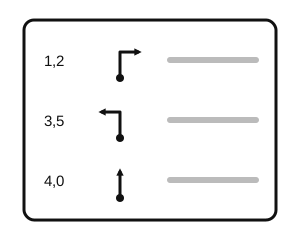
Each team's handbook: it holds the schedule, the times and the entire route – usually via tulip diagrams and distance figures. The basis of every rally.
Rotes Kennzeichen
Umbrella term for Germany's red recurring-use plates – depending on the leading digits 05 (inspection), 06 (dealer) or 07 (historic vehicles).
S
Sanduhrklasse
Rally category in which only mechanical measuring and timing devices are permitted.
Scrutineering
The inspection of the vehicle to establish its roadworthiness and its compliance with traffic law and the event's conditions.
Secret control
A timing point not announced to the crews. It records the transit time unnoticed and thus reveals deviations from the prescribed target time or average speed.
Silent controls
Unmanned controls that verify the route driven: number or letter codes or place-name signs that the crew records in order on its control card.
Special
A deliberately and skilfully built one-off, usually created for sporting purposes from period components – the kinder sibling of the bitsa, especially in the pre-war world.
Special stage
A defined section of route where the crew's precision is measured (abbreviated SS).
Sporting official
An official who oversees the safety of participants and spectators, coordinates timing and ensures compliance with the rules – responsible for a section and its marshals.
Spot height
A height figure printed at a specific point on British maps. In navigational rallies it serves as a precise waypoint that the navigator locates and plots.
Star rally
Event format in which participants start from different directions and converge on a common destination.
Start number
Number allocated to each team, displayed on the car and determining the start order; cars start individually at fixed intervals.
Stopping zone
Marked area on the route where the vehicle must stop or wait – for example before a time control until the target time.
Supplementary regulations
The official rule set of a classic-car event. It sets out entry conditions, contacts, the entry fee, scoring, penalties and the prize-giving, and is binding on everyone who enters.
Sweeper
The last car of an event, following the whole field: it picks up crews who have broken down, sees controls dismantled and reports the route clear. The counterpart to the zero car.
T
Target time
The exact time in which a section of route must be covered.
Time card
Control card issued by the organiser on which arrival and passage times are recorded or stamped at the controls.

Time control (TC)
Marked control point where a crew's arrival time is recorded against the target time (abbreviated TC).
Time trial (TT)
A scored section where a single prescribed target time must be hit as exactly as possible (abbreviated TT). Unlike a regularity test, the target time counts, not a constant average.
Trap
In Anglo-American 'course' or 'trap' rallies, a deliberately misleading instruction designed to lead the crew off the correct route.
Tripmeter
A precise supplementary instrument for measuring the distance driven – more accurate than the standard odometer. The co-driver's key tool, often called a tripmaster.
TSD rally
Time-Speed-Distance rally: a regularity format in which prescribed averages, derived from time, speed and distance, must be kept exactly.

Tulip
The modern roadbook symbol for a junction seen from above: dot = entry, arrow = exit, distance figure between them. Now replacing the term Chinesenzeichen.
Twelve-car rally
A short British beginner navigational rally limited to twelve cars, usually on a weekday evening, to keep the impact on residents low.
V
Veteran vehicle
The official Swiss term for a vehicle first registered more than 30 years ago. The status is entered in the registration document and brings registration advantages.
VHRS
French vehicle category: Véhicules Historiques de Régularité Sportive – historic cars eligible for regularity rallies.
W
Wanderpause
German term for the break during an Oldtimerwandern. Small, often fun tasks may be set. Abbreviated WP – not to be confused with the Wertungsprüfung (scored test).
Wildcard
A 'free pass' granted by the organising committee: it allows free entry or the start of a vehicle that does not otherwise match the supplementary regulations.
Y
Youngtimer
A younger collectible vehicle, usually around 20 to 29 years old – younger than an Oldtimer. FIVA lists youngtimers as Class Y.
Z
Zero car
Course car (numbered 0, 00 or 000) that drives the route ahead of the field without being scored.