
Chinesenzeichen
Traditional name for the junction symbols in the roadbook (dot, line and arrow drawings). Today increasingly replaced by the term tulip.
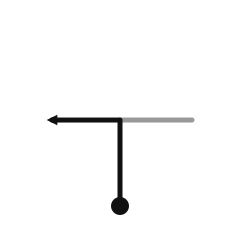
What are Chinesenzeichen?
Chinesenzeichen are the traditional name for the schematic junction symbols in the roadbook – more neutrally also called dot, line and arrow drawings. They depict crossroads, junctions and forks in stylised form from a bird's-eye view. They are the same symbol as the tulip; the term Chinesenzeichen is today increasingly replaced by ‘tulip’.
How to read them
A dot marks the point where you enter the symbol, the arrowhead the point where you leave it – so you drive from the dot to the arrowhead. The other strokes show the roads that exist but are not to be driven. Between two symbols there is a distance figure, so that each symbol maps unambiguously to a point on the route. Supplementary symbols such as traffic lights, stop signs or street names make orientation easier.
By terrain or by map
As with the tulip, the organiser states whether you drive by nature or by map. In navigation events, Chinesenzeichen are one of the classic task formats – alongside map extracts and the herringbone. Anyone who has mastered the tulip can also read Chinesenzeichen: the principle is identical.
Even though many organisers now write ‘tulip’, you will still regularly meet the term Chinesenzeichen in older regulations and at tradition-rich navigation events. It is always read the same way – from the dot to the arrowhead – so the change of name makes no practical difference.
Glossary from A to Z
Related terms
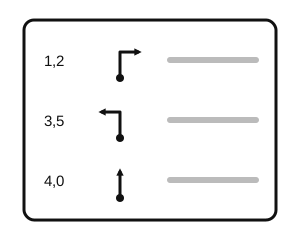
Roadbook
Each team's handbook: it holds the schedule, the times and the entire route – usually via tulip diagrams and distance figures. The basis of every rally.
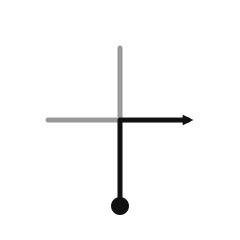
Tulip
The modern roadbook symbol for a junction seen from above: dot = entry, arrow = exit, distance figure between them. Now replacing the term Chinesenzeichen.
Bol-pijl
A Dutch-Belgian navigation system: at each junction a dot ('bol') marks your position and an arrow ('pijl') shows the direction to take. Read from left to right.