
Tulip
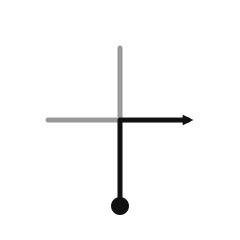
The modern roadbook symbol for a junction seen from above: dot = entry, arrow = exit, distance figure between them. Now replacing the term Chinesenzeichen.
What is a tulip?
The tulip (tulip diagram) is the common roadbook symbol that shows a junction or turning schematically from a bird's-eye view. It owes its name to its flower-like shape. ‘Tulip’ is the modern term that is increasingly replacing the traditional name Chinesenzeichen.
How to read a tulip
A filled dot marks the point where you enter the junction; the arrowhead shows where you leave it. The other strokes represent the roads and tracks that exist at this point but which you do not take. Between two tulips there is a distance figure (usually accurate to 10 metres), so that each symbol maps unambiguously to a point on the route. For better orientation, tulips are often supplemented with extra symbols – such as a traffic light, a stop sign or a street name.
By terrain or by map
The organiser states whether you drive ‘by nature’ (as the surroundings show) or by map. Together with the tripmeter, the tulip reliably guides you to the finish even through unfamiliar territory.
A common mistake is to read the tulip the wrong way round: the filled dot is always the entry, the arrowhead always the exit – regardless of how the symbol is rotated on the page. Where several junctions follow close together, it helps to count out the distance figures aloud.
Glossary from A to Z
Related terms
Roadbook
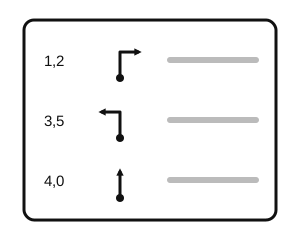
Each team's handbook: it holds the schedule, the times and the entire route – usually via tulip diagrams and distance figures. The basis of every rally.
Chinesenzeichen
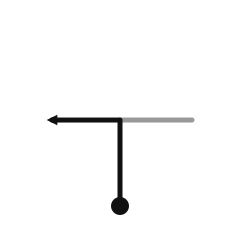
Traditional name for the junction symbols in the roadbook (dot, line and arrow drawings). Today increasingly replaced by the term tulip.
Bol-pijl
A Dutch-Belgian navigation system: at each junction a dot ('bol') marks your position and an arrow ('pijl') shows the direction to take. Read from left to right.