
Herringbone
Navigation task in which a central spine line with side ticks shows the roads a route passes without turning into them.
The herringbone, also called a fishbone, is a classic task in navigation rallying. Instead of a roadbook with tulips, the crew receives a schematic drawing resembling a fish skeleton: a continuous central line represents the route to be driven, with short ticks branching off to the left and right. These ticks stand for roads the crew passes without turning into them.
The crew's task is to find a way through the real road network in which the side roads are passed in exactly the order shown and on the correct side, left or right. The central line is usually read from bottom to top. Read it correctly and you follow the intended route flawlessly; a misread quickly leads you astray. The herringbone is therefore one of the most popular and at the same time trickiest navigation tasks.
Glossary from A to Z
Related terms
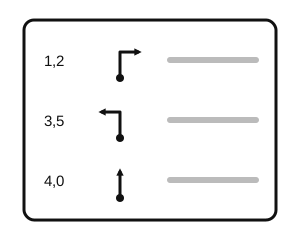
Roadbook
Each team's handbook: it holds the schedule, the times and the entire route – usually via tulip diagrams and distance figures. The basis of every rally.
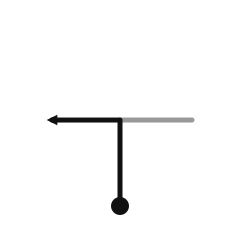
Chinesenzeichen
Traditional name for the junction symbols in the roadbook (dot, line and arrow drawings). Today increasingly replaced by the term tulip.
Regularity rally
Classic-car motorsport where precision counts, not speed: hold prescribed average speeds and target times as exactly as possible.